

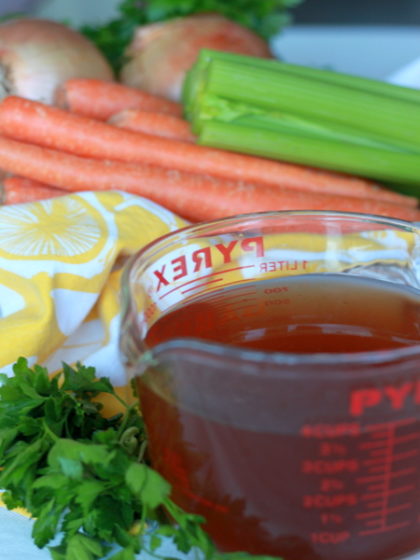
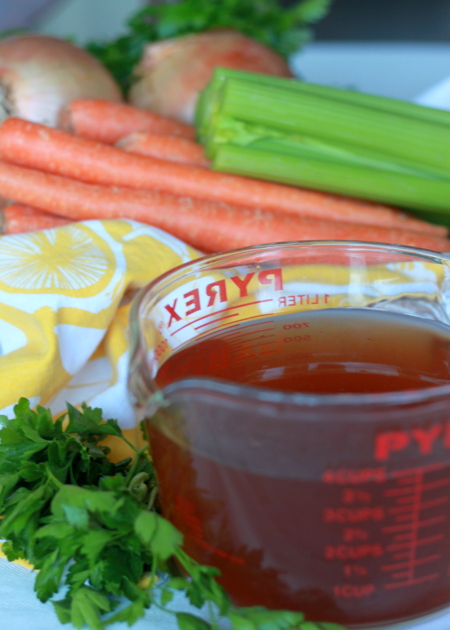
Gobs of my recipes call for vegetable broth. Even, say, soup that could have chicken in it. The main reason is obvious: most of what I make starts out vegetarian, the meat added later to only a portion for my resident carnivore.
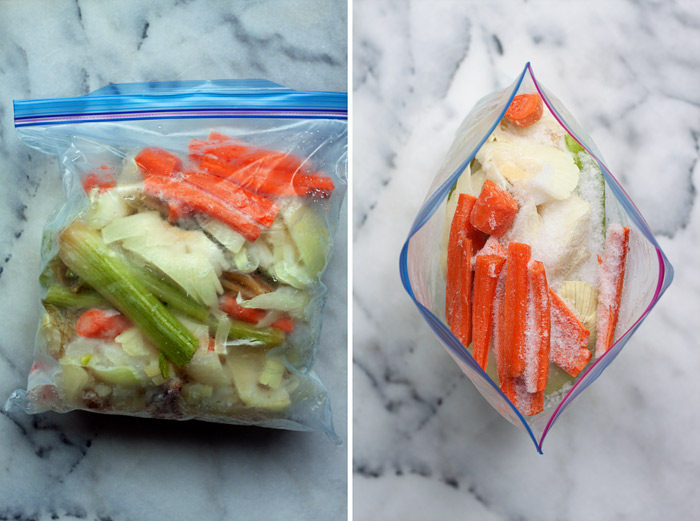
So, a few years ago, I started saving my veggie and herb scraps and freezing them in a gallon freezer bag. When the bag is packed to the brim, I brew up a big old pot of vegetable broth concentrate. Then I freeze it in measured portions and take it out as I need it, adding water and sometimes salt and, voila: veggie broth!
What is vegetable broth made of?
My homemade vegetable broth recipe always contains the following foundation vegetables:
- Carrots
- Celery
- Onion
Other vegetables that work well in vegetable broth:
- Shallots
- Mushrooms
- Parsnips
- Turnips
- Rutabagas
- Leeks
- Scallions
- Parsley leaves & stems
- Sage
- Thyme
- Rosemary
In addition, my vegetable broth contains:
- Water
- Salt
- Bay leaves
- Peppercorns
To get a gallon-bag full, I just throw my scraps in a designated bag and once it’s full, I make some broth! I peel an onion – the peel goes in the bag (after washing). I chop off the ends of a bunch of celery – into the bag. A couple of carrots languish in the bottom of the produce drawer. I stick them in the bag before they go bad. You get the drift.
Not only do I save a ton of money by making my own vegetable broth from my discards, it adds such a wonderful depth of flavor to dishes that I never quite get from store-bought broth. And I love being able to control the amount of salt that goes into a final recipe.
Homemade Vegetable Broth from Scraps
Ingredients
- One-gallon freezer bag full of assorted vegetable and herb scraps: onion ends and peels (celery bits and leaves, carrot peels and ends, shallots, parsnips, turnips, rutabagas, leeks, scallions, parsley stems, sage, bits of thyme, rosemary - anything you want, really, though I do avoid lettuce and cucumber.)
- About 12 cups of water (to start)
- One or two bay leaves
- 1 teaspoon peppercorns
Instructions
- After you've amassed a gallon-sized freezer bag full of veggies from days of diligent scrap-gathering, dump the frozen contents of the bag into a large stock pot.
- Fill the pot with water about 3 inches from the top - I end up adding around 12 cups of water initially.
- Add the bay leaves and peppercorns.
- Lightly push the vegetables down with a wooden spoon. Avoid stirring at any time during the process - that can make the broth cloudy.
- Over medium heat, bring to a boil. Lower heat to medium-low, keeping at a steady, simmer.
- Simmer until the liquid has reduced by just about half - this takes about an hour.
- Add enough water to return the liquid to its former level. Push the veggies down every once in awhile.
- Bring to a simmer again, and again continue to simmer until the liquid has reduced by half, about another hour.
- Remove from heat and allow to cool.
- Strain the broth concentrate by first pouring it through a colander and then pouring it through a fine-mesh sieve.
- Pour the broth concentrate into containers in 1/2 cup, 1 cup, or 2 cup increments. A standard muffin tin is 1/2 cup, and works well here.
- When the broth concentrate has frozen completely, remove from the freezer and place the chunks in a labeled freezer bag.
- When you're ready to use the broth, bring out a broth concentrate cube and place it in a bowl. Pour an equal amount of hot water over the broth cube (if the broth cube is 1/2 cup, add 1/2 cup water) and and, if desired, add 1 teaspoon of salt per 1 cup of finished broth.
- You may need to microwave the frozen broth concentrate to thaw it completely, or let it sit on the counter for a bit until it thaws. Depending on the recipe, I'll just add it frozen and adjust the recipe times accordingly.

 I’m so glad you’re here! I’m a vegetarian home cook, certified plant-based pro, and mom. I’m married to an enthusiastic carnivore, and my mission is to achieve peace in the kitchen – one tasty recipe at a time. These days, with a name like mine, I also try not to ask to speak to the manager.

I do the same thing! Except, I mainly pressure can my broth after I make it … to conserve freezer space! But I love making my own broth, you can control the sodium, and the flavors in the broth!
Pingback: Tuesday Tip: Use Muffin Tins for Freezing | Kitchen Treaty
Great idea! Thanks
Pingback: Cheddar Corn Chowder with Optional Bacon | Kitchen Treaty
Pingback: Roasted Red Pepper & Tomato Soup | Kitchen Treaty
Pingback: Roasted Winter Vegetable Chowder | Kitchen Treaty
Pingback: 40 Cloves of Garlic Soup | Kitchen Treaty
Pingback: Crock Pot Vegan Black Bean and Brown Rice Soup | Kitchen Treaty
Pingback: Easy Vegetarian Crock Pot Refried Beans (without Lard!) | Kitchen Treaty
Pingback: Pumpkin Ale Beer Cheese Soup with Sharp Cheddar and Gruyere | Kitchen Treaty
Pingback: This Month’s Bits & Bites: January 2014 | Kitchen Treaty
Have you tried this using the crock pot? Seems like it could work, too…
I think I just pinned half of your blog. Thanks for the recipes! I’ve been saving my veggie scraps but have yet to make the broth. Glad I found this process!
Quick question – if you free the broth in a muffin tin before putting it in another container, do the cubes pop out easily? Or do you put something in them first?
Hi Amber, thank you for the pins! 🙂 The cubes do pop out of the muffin tins pretty easily – you just have to let them sit at room temp for a couple of minutes and then if they don’t pop out easily just pop them out with a butter knife. These days I actually usually freeze the broth in one- and two-cup increments because I usually use larger amounts at a time.
I LOVE your ideas! Thank you so much for sharing a ring them. What kind of containers do you use to freeze the broth in, please? I need to make up some in advance AND I need 10 C for a Barley soup I want to try. I don’t have enough one cup containers to freeze enough liquid for the soup, let alone for future use. Do you suggest I invest in a lot of measuring cups? I like the cupcake tin idea,…but what is your secret for freezing large quantities of broth?
p.s. would you please send me an e-mail with your answer as well as this post, please? I fear I won’t be able to find this area again!
Thank you so much, Linda! Sometimes I use glass storage containers or large mason jars (leaving room in them for expansion). The easiest is gallon-size freezer bags. It’s a bit messy to fill them but they hold a lot and store flat. You should be able to get 5 cups of concentrate in one of those no problem.
I made the broth and froze it in an ice cube tray and now i’m adding a few ice cubes to every soup I make.
The soups are amazing! Each soup has such a rich flavor.
Thanks!!
Shoot. I put my broth on the stove on very low, for the past 6 hours (covered, in a Dutch oven). Is it not going to work? Should I switch midstream this morning, after it has been on low on the stove 6 hours, and begin your method?
I had so much veggie scrap that I put half in the crock pot on low all night (6 hrs so far), and the other half in a Dutch Oven on top of the stove.
Thanks for the tips! I like to add the rinds from parmesan cheese to my freezer bag of scraps. I freeze the broth in 32 oz. plastic containers (size of a large yogurt container), which is just enough broth for two bowls of tortellini, which I buy in bulk and freeze. It’s my go-to dinner when I don’t feel like cooking.